Introduction
Learning how to reconstitute peptides correctly is essential for maintaining stability, accuracy, and consistency in research settings. Improper handling can degrade peptide integrity, impact concentration, and compromise results.
This guide covers the fundamentals of peptide reconstitution, including what it is, why it matters, and best practices for handling, storage, and preparation.
What is Peptide Reconstitution?
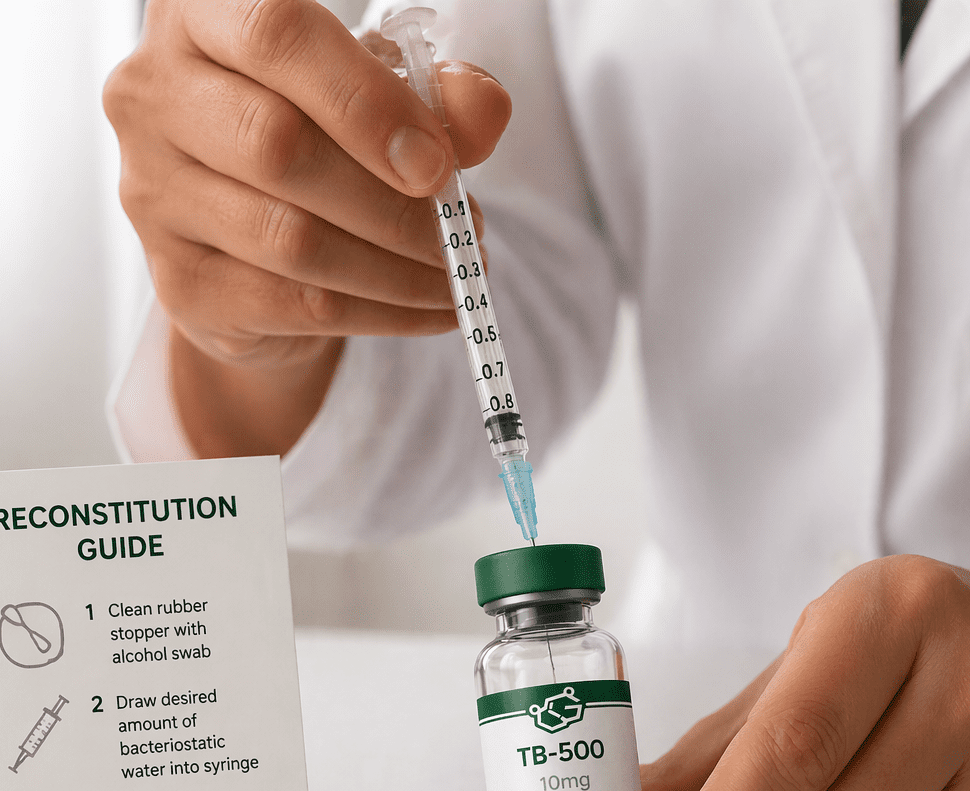
Peptide reconstitution refers to the process of adding a sterile diluent to a lyophilised (freeze-dried) peptide powder to create a liquid solution.
Lyophilisation is used to:
- Improve peptide stability
- Extend shelf life
- Protect against degradation during storage
Reconstitution allows the peptide to return to a usable liquid form for research applications.
Why Proper Reconstitution Matters
Correct reconstitution directly affects:
- Peptide stability – reduces degradation
- Solution accuracy – ensures correct concentration
- Reproducibility – consistent results across experiments
- Shelf life – extends usability after mixing
Improper technique can lead to:
- Denaturation of the peptide
- Bacterial contamination
- Inaccurate concentrations
What You Need for Peptide Reconstitution
Before starting, ensure you have appropriate materials suitable for controlled lab environments.
Common Components
- Lyophilised peptide vial
- Sterile diluent (commonly bacteriostatic water in research contexts)
- Sterile syringe
- Alcohol swabs
- Clean, controlled workspace
Understanding Dilution and Concentration
Reconstitution involves creating a known concentration by adding a specific volume of diluent.
Basic Concept
- Peptides are supplied in a fixed mass (e.g. mg)
- Diluent is added to create a solution with a measurable concentration
This allows for precise measurement and consistency across experiments.
Tip: Always document your dilution ratios to maintain reproducibility.
Step-by-Step Peptide Reconstitution Guide
After reading out step by step you can follow along a great video demonstration by LaSara Medical Group View demonstration
1. Prepare a Clean Environment
Work in a clean, controlled area to minimise contamination risk.
2. Sanitize Vial Tops
Use alcohol swabs to clean:
- Peptide vial
- Diluent vial
Allow to dry before proceeding.
3. Draw the Diluent
Using a sterile syringe, draw the required amount of diluent.
4. Add Diluent to the Peptide Vial
Slowly introduce the liquid down the side of the vial.
Important:
- Avoid direct force onto the powder
- Do not shake aggressively
5. Allow the Peptide to Dissolve
Let the vial sit and gently swirl if needed.
- Do not shake
- Avoid creating foam
6. Label the Solution
Include:
- Date of reconstitution
- Peptide name
- Concentration
Best Practices for Reconstitution
To maintain peptide integrity:
- Avoid shaking — gentle swirling only
- Use sterile technique at all times
- Store according to stability guidelines
- Minimise repeated exposure to air
Storage After Reconstitution
Once reconstituted, peptides require proper storage: Read more about storage
General Guidelines
- Store in refrigeration (commonly 2–8°C in research contexts)
- Protect from light exposure
- Avoid repeated temperature fluctuations
Common Mistakes to Avoid
- Adding diluent too quickly
- Shaking the vial
- Using non-sterile equipment
- Not recording concentration
- Improper storage conditions
Frequently Asked Questions
How long do reconstituted peptides last?
Stability depends on the specific peptide and storage conditions. Always refer to supplier guidance.
Can peptides be stored at room temperature?
Typically not recommended after reconstitution, as stability may decrease.
Why is my peptide not dissolving?
Some peptides require time to fully dissolve. Gentle swirling and patience are key.
Conclusion
Understanding how to reconstitute peptides properly is critical for maintaining accuracy, stability, and reliability in research applications. By following structured handling practices and maintaining controlled conditions, you can ensure consistent results and preserve peptide integrity.